Hailar Battle and Mamiya’s Capture
The Wind-Up Bird ChronicleLieutenant Mamiya’s wounding and capture near Hailar turned a deliberate attempt to die in battle into the beginning of a long captivity. On August 13, 1945, he joined a suicidal attack on a Soviet tank, lost his left hand beneath its treads, and survived after speaking Russian while unconscious. His survival carried him from the collapsing front into a Soviet military hospital and, ultimately, forced labor in Siberia.
Assignment and the Coming Battle
Before the fighting, Lieutenant Mamiya served with the Military Survey Corps of the Kwantung Army General Staff in Hsin-ching. He was responsible for topographical work along the western border of Manchukuo near the Khalkha River, where incomplete maps had both military and diplomatic significance. In a region where borders remained politically sensitive, more detailed terrain information could support combat planning without immediately forcing an official settlement of the boundary.
That mapping work reflected the army’s wider logistical vulnerability. Combat maps needed to identify routes, encampments, artillery positions, water sources, and the time required for infantry and supplies to move. Earlier planning for a possible winter war with the Soviet Union had likewise exposed inadequate preparation: army researchers concluded that Japanese forces lacked equipment for a Siberian winter and estimated that frostbite could disable a large share of front-line infantry. These details frame the Hailar battle not as an isolated test of courage but as part of a war shaped by the army’s limited preparation and resources.
The Attack and Survival
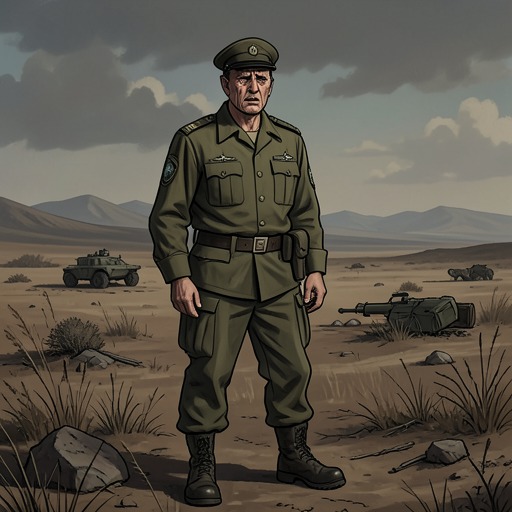
By August 1945, the Kwantung Army was being pushed toward collapse as Soviet forces advanced into Manchuria. Although Lieutenant Mamiya had been assigned to withdraw with the Military Survey Corps, he arranged to transfer to the Hailar unit near the border, intent on dying in battle. On August 13, he attacked a Soviet T34 tank with a land mine in his arms. The attack was futile: his small portable mine could not damage the tank, and the men under his command were killed. Mamiya was struck by machine-gun fire and lost his left hand beneath the tank’s treads, but he survived—contrary to the prediction Mr. Honda had made by the Khalkha River that Mamiya would not die so easily.
Capture and Forced Labor
Unconscious, Lieutenant Mamiya was taken to a Soviet military hospital in Chita, where surgeons saved his life. His ability to speak Russian proved decisive: he had studied the language before the war and developed his fluency while serving in Hsin-ching, practicing with Russian residents and waitresses. The Soviet Army needed interpreters for the Japanese prisoners it planned to send to Siberia as forced labor. When Mamiya spoke Russian while delirious, the soldiers recognized a use for him and sent him to the hospital rather than leaving him to die near Hailar.
After an interrogation and months of ideological training, Mamiya was sent to a Siberian coal mine as an interpreter, acting as a liaison between Japanese prisoners and their Soviet captors. There, he witnessed a system in which prisoners died from hunger, overwork, accidents, disease, cold, and violence; deaths were handled by placing bodies in abandoned mine shafts. The mine’s leadership treated workers as replaceable units, bringing in new prisoners as the labor force dwindled. His capture thus extended the consequences of the Hailar defeat well beyond the battlefield: survival depended on a linguistic skill acquired during military service, but it led into another coercive wartime system.
Political Collapse and the Camp System
The battle at Hailar occurred as the Soviet advance exposed the disintegration of Japanese power in Manchukuo. The Kwantung Army, weakened by the transfer of troops and equipment to other fronts, evacuated its main force and left border garrisons and Japanese civilian settlers exposed. Chinese soldiers assigned to defend the capital deserted or rebelled rather than die fighting the Soviet Army. The retreat and collapse formed the larger setting for Lieutenant Mamiya’s capture: military defeat brought Japanese prisoners into the Soviet labor system, where his language skills first preserved his life and then determined his role.
Mamiya’s experience of that system also shaped his understanding of political authority. He could not accept communist principles as practiced by a government responsible for repression in Mongolia and the Soviet Union, and he drew a parallel with Japanese actions in Manchuria. He knew that Chinese laborers had been deliberately killed to conceal the construction of the secret base at Hailar. In his account, the rival regimes’ claims and ideologies could not be separated from the violence used to maintain them.
From Interpreter to Witness
The Siberian mine treated prisoners as expendable labor. Its director pursued rising production figures, authorizing work in dangerous coal seams despite mounting accidents; when workers died or the labor force declined, new prisoners arrived by train. Mamiya served as an intermediary between Japanese prisoners and their Soviet captors, but his position did not shield him from witnessing the mine’s routine deaths and punishments. The episode extends the meaning of his survival at Hailar: being spared on account of his Russian did not release him from wartime violence, but drew him into a role from which he could observe its machinery at close range.
Years later, Mamiya returned to the Hailar battle in a sequel to the story he had previously told Toru Okada. He explained that practical limits had kept him from recounting everything earlier, but that he had also not been emotionally prepared to tell the rest fully and honestly. The delayed account makes the capture more than a military turning point: it is a remembered wound whose consequences reach from the battlefield into captivity, and whose full narration itself comes only afterward.